Kansas Forest Service
Detecting and Tracking the Spread of Emerald Ash Borers in Kansas
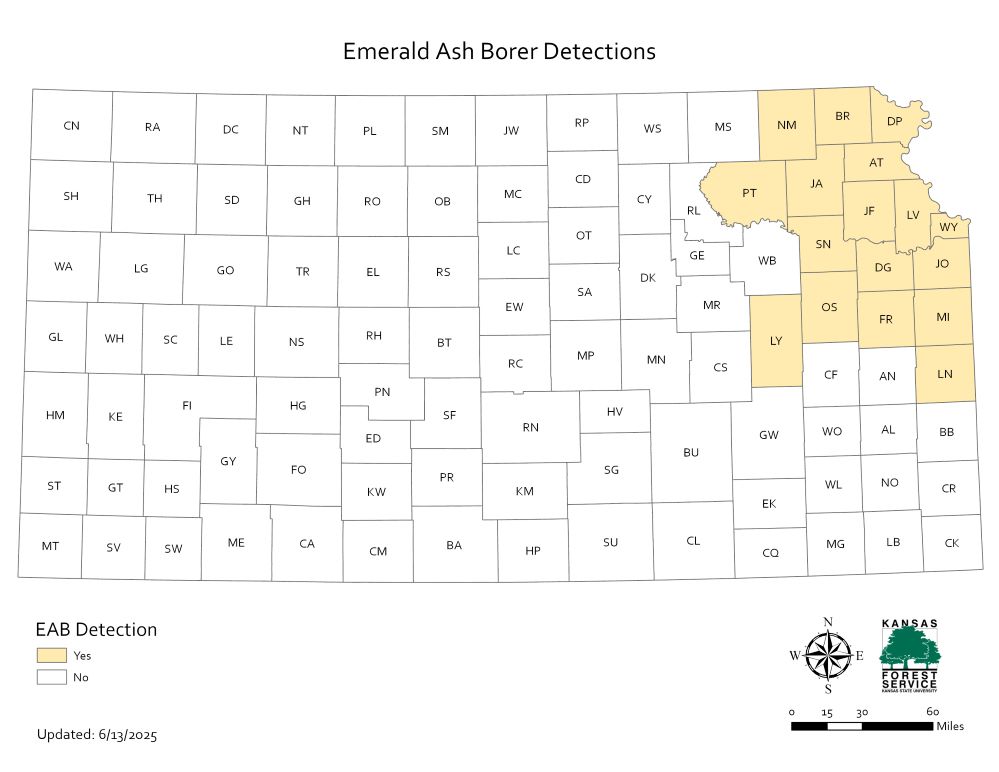
It has been nearly 25 years since the emerald ash borer (EAB) was first detected in the United States. Since then, it has spread to at least 37 states, including Kansas, where it was first confirmed in 2012 in Wyandotte County. Today, 18 Kansas counties have verified EAB infestations, and the trend shows no signs of slowing. This is significant and concerning news for Kansas, which is home to an estimated 65 million ash trees – approximately 93% of which are found on privately-owned forest land. Across the country, EAB has already killed hundreds of millions of ash trees across rural, urban, and riparian landscapes, causing widespread ecological, economic, and societal harm.
Understanding where EAB is and likely to appear next is critical to anticipating and mitigating these impacts. The Kansas Forest Service recognizes the value of early detection and actively works to track and monitor the spread of EAB – along with other pests, pathogens, and invasive species – across the state. Following the first finding in 2012, the Kansas Forest Service has actively supported subsequent detections in: Wyandotte (2012) Johnson (2013) Leavenworth (2014) Douglas (2015) Jefferson (2015) Atchison (2016) Doniphan (2017) Shawnee (2017) Miami (2019) Jackson (2019) Brown (2022) Osage (2022) Franklin (2023) Lyon (2024) Nemaha (2024) Linn (2025) Pottawatomie (2025) Bourbon (2025) Over those years, the Kansas Forest Service has partnered with the Kansas Department of Agriculture to place 10-20 trap trees in counties where EAB had not yet been detected. This strategy has proven invaluable for providing early EAB detection and notification to communities, allowing mitigation strategies to be implemented before local impacts escalate.
After feeding for a few weeks in late spring and early summer, adult female EAB lay eggs on the bark of ash trees. The eggs hatch in 7-10 days, and the larvae begin to burrow into the tree where they feed on the inner bark and phloem. The larvae continue to feed within the vascular tissue of the tree throughout the summer months and disrupt the tree’s ability to transport water and nutrients – damage that ultimately kills the tree. When EAB populations are low, it can take several years for a large, and otherwise healthy, ash tree to significantly decline or die.
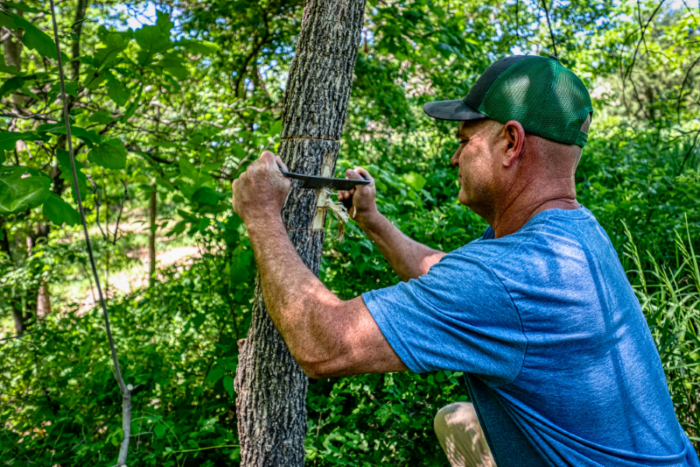
Trap trees are typically installed just before or during adult emergence, ensuring they are available to serve as hosts. In 2025, the Kansas Forest Service, in collaboration with KDWP, USFWS, the U.S. Army Corps of Engineers, local communities, and private landowners, set trap trees in 11 counties adjacent to known infestations. Later this fall, those trees will be felled, peeled, and carefully examined for EAB larvae.
Emerald ash borer “trap trees” are ash trees that have been intentionally girdled – a process in which a continuous ring of bark is removed from a section of the trunk – for detection and monitoring purposes. Girdling injures the tree and prompts stress-induced chemical changes that attract EAB and make the tree a more desirable host. If the insects are already present in the area, trap trees are likely to become a feeding site for both adult and larval EAB.
Unfortunately, “success” with EAB trap trees means that insect specimens have been found and new infestations confirmed. Though positive detections underscore the destructive reality these invasive insects bring, they provide the critical step for changing speculation into confirmation. Each detection serves as a catalyst for conversation, awareness, and action.
In response, the Kansas Forest Service issues press releases, hosts EAB workshops, shares information through social media, and, in 2025, began sharing “EAB Detection Notices” with affected counties and communities. These notices are designed to be shared with our local partners and community leaders so they can be further distributed as direct mail, emails, handouts, and bulletins to help ensure that awareness of EAB spreads as widely as the insect itself.
Shad Hufnagel
Forest Health Coordinator
Kansas Forest Service
Learn More About Emerald Ash Borer
This article first appeared in the Kansas Forestry Association Newsletter.