Kansas Forest Service News
State Champion Blackjack Oak
At the edge of a pasture in rural Anderson County, right at the margin between grass and forest, stands the largest blackjack oak in the state of Kansas.
Upon first seeing it, an observer might assume it’s one of the multitude of similar bur oaks that have persisted here at the ecotone between woods and range for hundreds of years. It’s a similar size and shape, and fills a similar niche in the open woodlands and savannas of eastern Kansas.
However, upon close inspection several distinctive features stand out – the club-shaped, almost leathery leaves and the alligator-skin bark are most prominent. Most blackjack oaks do not reach this comparatively massive size (53 feet tall, 57 feet wide, 110 inches in circumference), which would be on the small end for a bur oak but truly exceptional for a blackjack that typically reaches 20-40 feet in height and spread.
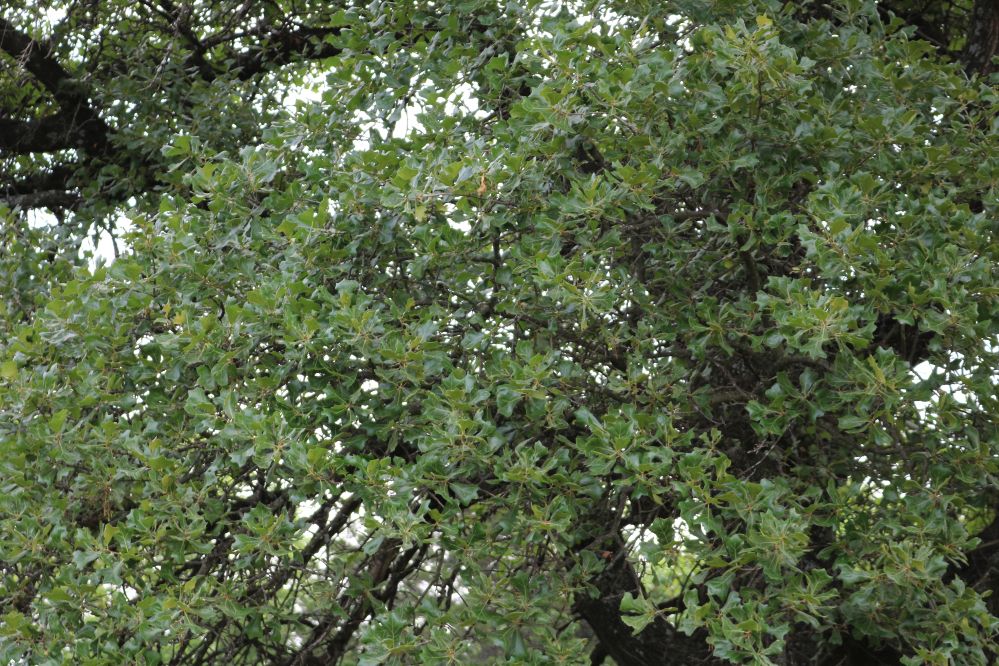
Leaves of the blackjack oak are club-shaped and leathery in texture.
The caretaker for this particular blackjack oak is landowner Pat Wittry, and she not only stewards this Kansas Champion Tree, but also protects its progeny with protective fencing and tree limbs sheltering small blackjack saplings nestled amongst the grass under its canopy. The tree sits on private land, and is not open to visitors, but as blackjack oaks are typical of the forest type in much of the Cross Timbers region that stretches from southern Anderson County down through Chautauqua County and then all the way to Dallas, you can be sure to find some fine examples on public lands such as Cross Timbers, Fall River, or Elk City State Parks. There are also some examples, though harder to find, along Black Jack Creek and near the Battle of Black Jack monument in Douglas County, near Baldwin City.
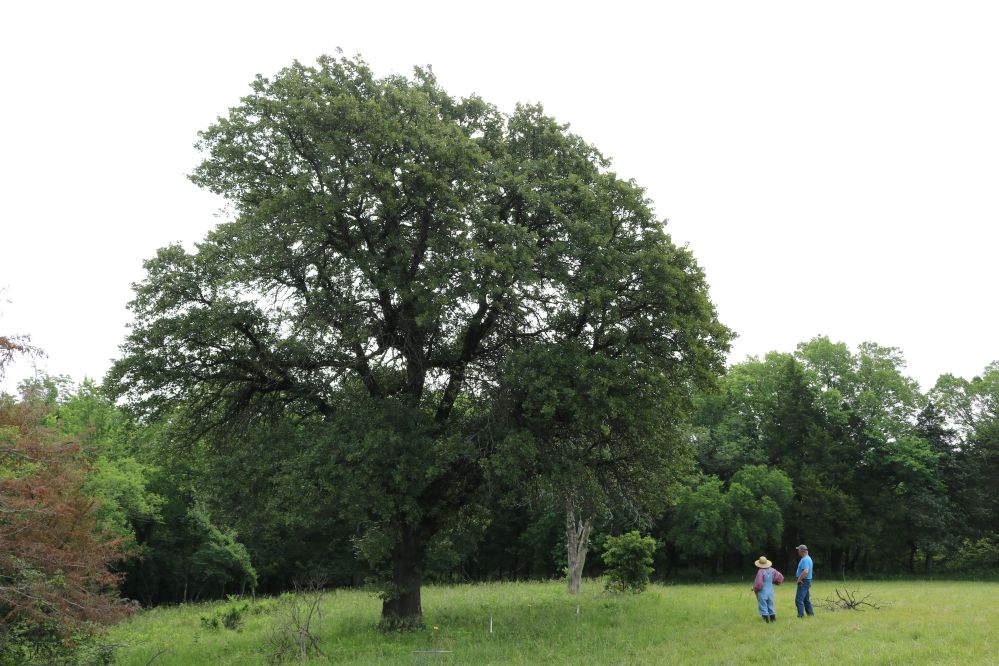
The current blackjack oak Kansas Champion tree in Anderson County.
Oaks in pasture, such as the champion in Anderson County, may give some landowners pause, rooted either in suspicions of woody conversion of rangeland or in risks to cattle. Happily, neither should cause removal of oaks in these savanna settings. According to Oklahoma State University, something of an authority on cattle and forage, “In the Southern Plains states, tannic acid poisoning in cattle that consume too many green oak leaves or acorns is not a frequently raised issue, mainly because the livestock don’t find them all that palatable and will generally only eat them if other resources are not available. The problem can be largely avoided by ensuring cattle have access to good grazing and supplemental feed.”
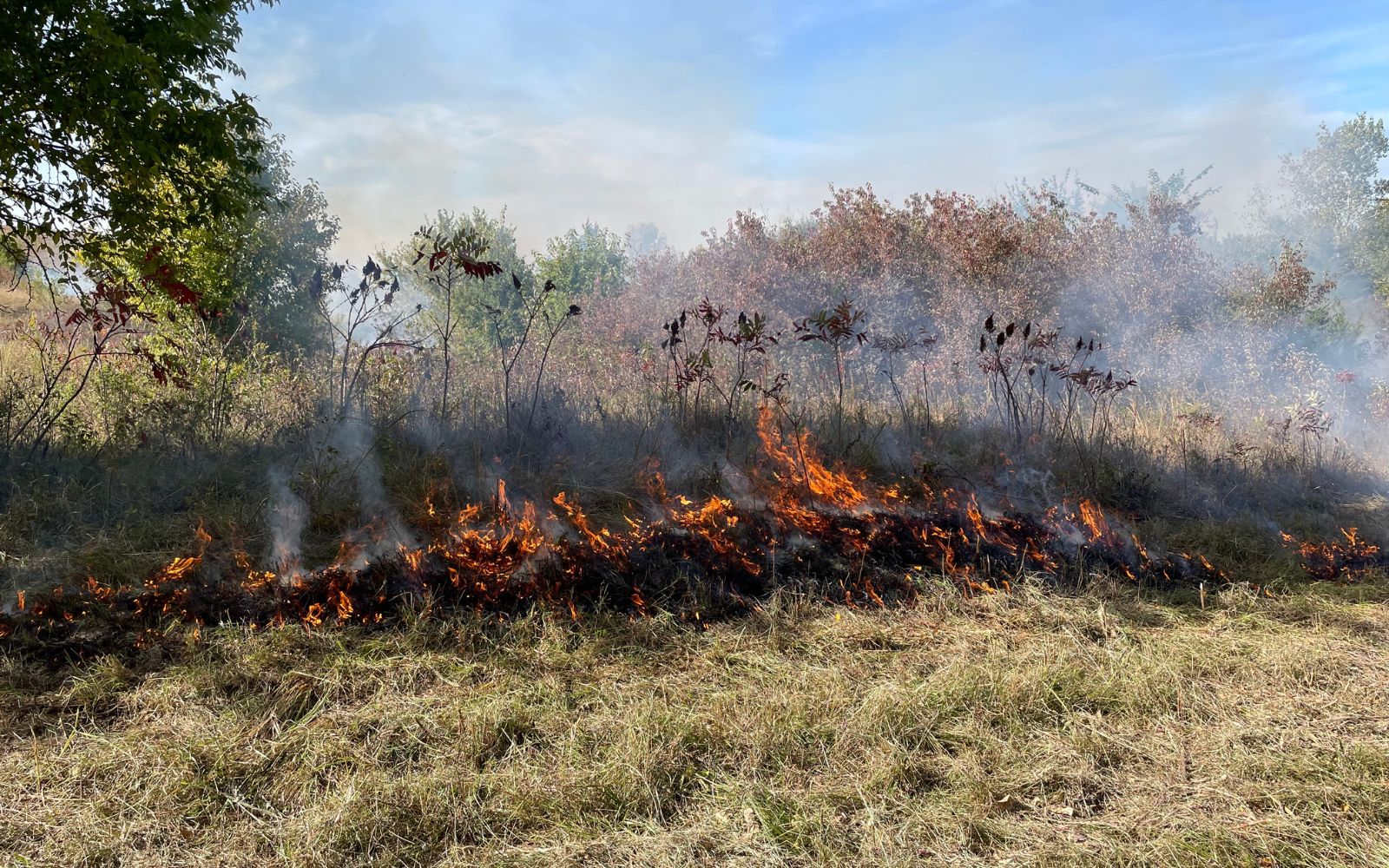
As for the legitimacy of oaks standing in grass, this blurred margin between vegetation types has been the tense reality in our part of the continent since the glaciers retreated and prairies and forest started to find a way to coexist about 8,000 years ago. Blackjack oaks are one of the most fire tolerant oak species, well suited for the dynamic interplay of grass and oaks in the margins of the prairie here. According to the USDA’s Fire Effect Information System, a reliable reference on these things, “Blackjack oak is nearly as fire tolerant as turkey oak and more fire tolerant than post oak and black oak. Smaller blackjack oaks are easily top-killed by fire, but sprout vigorously from the root crown. Under a normal fire regime (fire occurring every few years), a savanna is maintained because grass grows back faster than the woody sprouts after a hot fire. In the absence of fire, blackjack oak spreads and the grass dies back.”
Seedlings will preferentially allocate carbohydrate storage to roots, ready to absorb a few top-killing events from grass fires until the right conditions and sun allow for it to shoot up, thicken its insulating bark against low-intensity fires, and replace its parent trees in the canopy when they age out.
Patience is necessary for an oak, however, as it may take many years for an opportunity to arise. Blackjacks are typical of many of our native oaks in that they can be expected to live for multiple centuries. A blackjack in Oklahoma was recently core-dated to 230 years old, which means it germinated not long after the species was officially named!
In 1770, Otto von Münchhausen, a German botanist and correspondent of the famed Linnaeus, gave this species a name based on the somewhat uninspired fact that it was an oak found in the colony of Maryland – Quercus marilandica. The common name supposedly references the resemblance of the leaf to a sailors tool (and in some cases, self defense weapon) the leather-covered sand club called the “blackjack.”
The tree itself deserves this rough moniker, as it can typically be found on tough sites with thin, rocky soils and frequent fires. In fact, blackjacks seem to prefer these upland sites, and when planted on lowland sites with rich soils and frequent flooding, do not persist. They grow just a couple of inches a year, not able to outcompete the racing sycamores and cottonwoods or even the casual rate of growth of hickories, but on a thin rocky soil, a couple of inches a year and fire tolerance will result in many century trees.
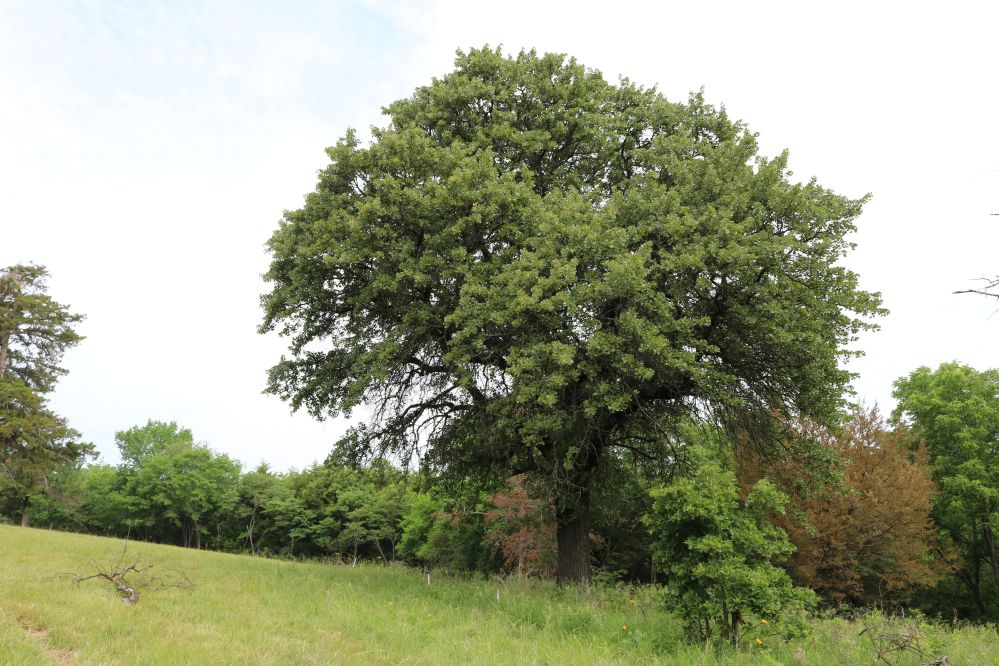
The current blackjack oak Kansas Champion tree in Anderson County.
Given its close association with the ancient Cross Timbers forest type, it is impossible to tell the story of blackjack oak without mentioning its frequent associate, the slightly more well-known post oak. While blackjack oak is the slow-growing representative of the red oak group, with its bristle-tipped leaves and slower-maturing acorns, post oaks come from the white oak group with smooth lobed leaves and acorns that grow in just one season. Post oaks grow at a similar rate, but are a little longer lived and a little larger than their blackjack oak cousins.
While they live, blackjack oaks offer food and habitat to incredible numbers of animals, both vertebrate and invertebrate. Oaks, as a genus, are some of the most valuable components of the insect-bird food chain, supporting hundreds of species of butterflies and beetles, including the White M Hairstreak butterfly and the Horace’s Duskywing.
When blackjacks do come down, their wood has little commercial timber value, but does have some value to the creative or sentimental woodworker or woodturner. And while its cousin the post oak may have more notoriety for fueling barbecues across Kansas, Oklahoma, and Texas, blackjack wood is also well-suited for the BBQ pit. It should perhaps not be used for indoor fireplaces, however, due to a tendency to pop and crackle which may be pleasing to listen to but can throw sparks.
Unfortunately, some blackjacks can perish prematurely due to a variety of causes. Pests and diseases that sometimes take down these trees include twolined chestnut borer, oak hypoxylon, and oak wilt. For blackjack oaks and other similar sensitive species, repeated exposure to some commonly used broadleaf herbicides (dicamba, triclopyr, 2,4-D) may result in chronic and sometimes acute stresses that lead to mortality. Selecting alternate management options, or being cautious of use of these in the lawn and pasture will limit risks to oaks and other susceptible species.
With thoughtful consideration for site and care, it’s likely that there are other large blackjack oaks in Kansas that will someday be around to assume the mantle of “Champion Tree” from the notable old specimen in Anderson County – but given the excellent site and stewardship of the current tree, it may be many decades!
Ryan Armbrust
Rural Forestry Program Coordinator
Kansas Forest Service