Kansas Forest Service News
State Champion Incense Cedar
The genus Calocedrus can be translated from Greek to mean “beautiful cedar”. This is a relatively small genus with only 4 species. These species have a native range from Taiwan (Calodecrus formosana) to California (Calocedrus decurrens), but they are popular ornamentals. C. decurrens is commonly known as California incense cedar and is mainly planted in Kansas for its landscape properties. Naturally, the California incense cedar occurs in mixed-conifer forests in the mountains from Oregon to Baja California. Incense cedar competes well on dry, hot slopes and may outgrow other species on poor sites in these regions, but is slow-growing relative to their associated species on productive sites (Powers and Oliver 1990).
California incense cedar is a tree with many desirable characteristics, both aesthetic and ecological. To start, it is a gymnosperm and part of the cypress family. This means that California incense cedars produce seed cones (with no ovary) and have small scale-like leaves at maturity, these traits are desirable because it limits lawn care to remove unsightly fruits or leaves. Other aesthetic characteristics include bright green foliage year-round, small inconspicuous seed cones (less than an inch long), and the sap has an incense-like odor. It also has few lethal insect pests and pathogen problems (Powers and Oliver 1990), so once planted outside of environmental impacts there are few problems to be cognizant of as a landowner.
Ecological characteristics that are desirable can be limited to the fire and drought adaptations. As mentioned above, California incense cedar is natively found in California which means these trees have an extensive history with drought and fire. This makes them reasonable ornamental trees for Kansas’ changing weather patterns and extended fire season. Drought resistance is achieved through two known mechanisms: 1) closing the gas exchange cells in their leaves to limit water loss and 2) its thick basal bark which allows the tree to maintain water and food transport during temperature fluctuations. A hypothesized mechanism of drought resistance is the well-developed root system with extensive lateral root structures that support arbuscular mycorrhizae, a characteristic that has been attributed to increased drought tolerance for other tree species (Auge 2001). The thicker bark is also key to making this tree fire resistant by providing a charable surface to prevent damage to the important living tissue beneath the bark of tree. These traits make this tree a safe option for ornamental trees for Kansas.
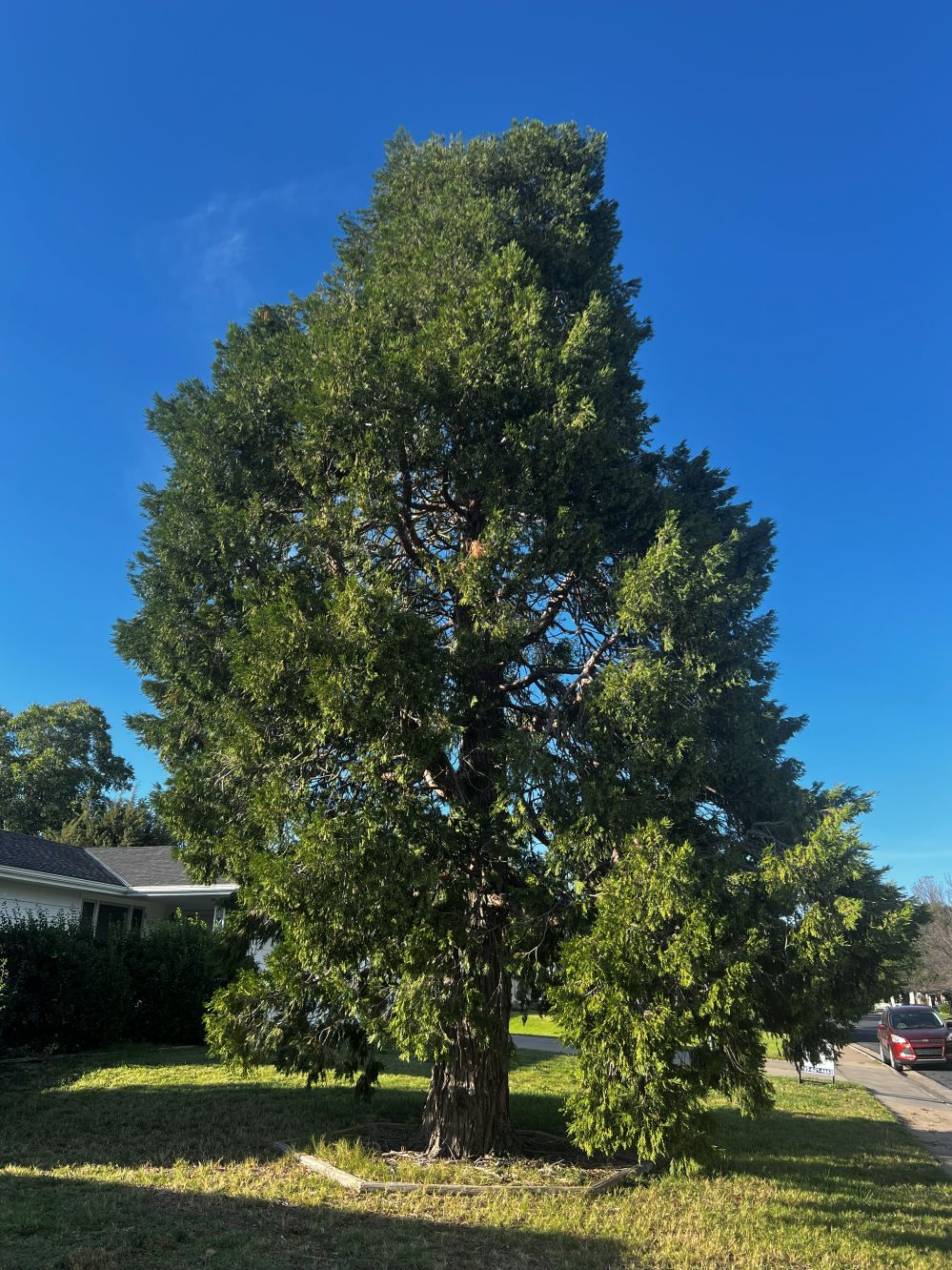
The current co-champion incense cedar in Hays.
At this point you might be thinking about using this tree in a planting around your house or community, but this tree should be used only in very specific circumstances. While it is hardy from zones 5 to 8, it does best in deep, well-drained yet reasonably moist soils (so lots of watering in the right soil type- not usually found outside riparian zones) and even in pristine growing conditions it is considered a slow grower. Another nuance to consider is that while the roots are an advantage at maturity, those spacious roots can make girdling roots common in nursery stock, and the quick development of a taproot can make transplanting this tree complicated and hard to do successfully.
To discern this species from our native eastern red cedar or other ornamental cedars look no further than the cones and leaves. The cones are single on the branch, with one pair of elongated scales, and open wide to release the seeds when ripe. The leaves are in whorls of four around the twigs. Our native and other ornamental cedars have berry like cones or upright cones with multiple paired scales. Their leaves are in arrangements of fewer than four whorled leaves or fewer than four leaves per node.
Kansas currently has co-champions of this species. One is in Hays, and one is in Belle Plaine. The Hays specimen sits on private land and is not open to visitors, but street viewing is possible from Hillcrest Drive. The Hays champion has a circumference of 87 inches, a height of 42 ft, a crown spread of 25 ft, and a total of 135 points; it was last measured in 2025. The Belle Plaine champion is located at the Bartlett Arboretum, which is accessible on Saturdays and Sundays from 9:00 am to 5:00 pm. The Belle Plaine champion has a circumference of 63 inches, a height of 58 ft, a crown spread of 40 ft, and a total of 131 points; it was last measured in 2023.
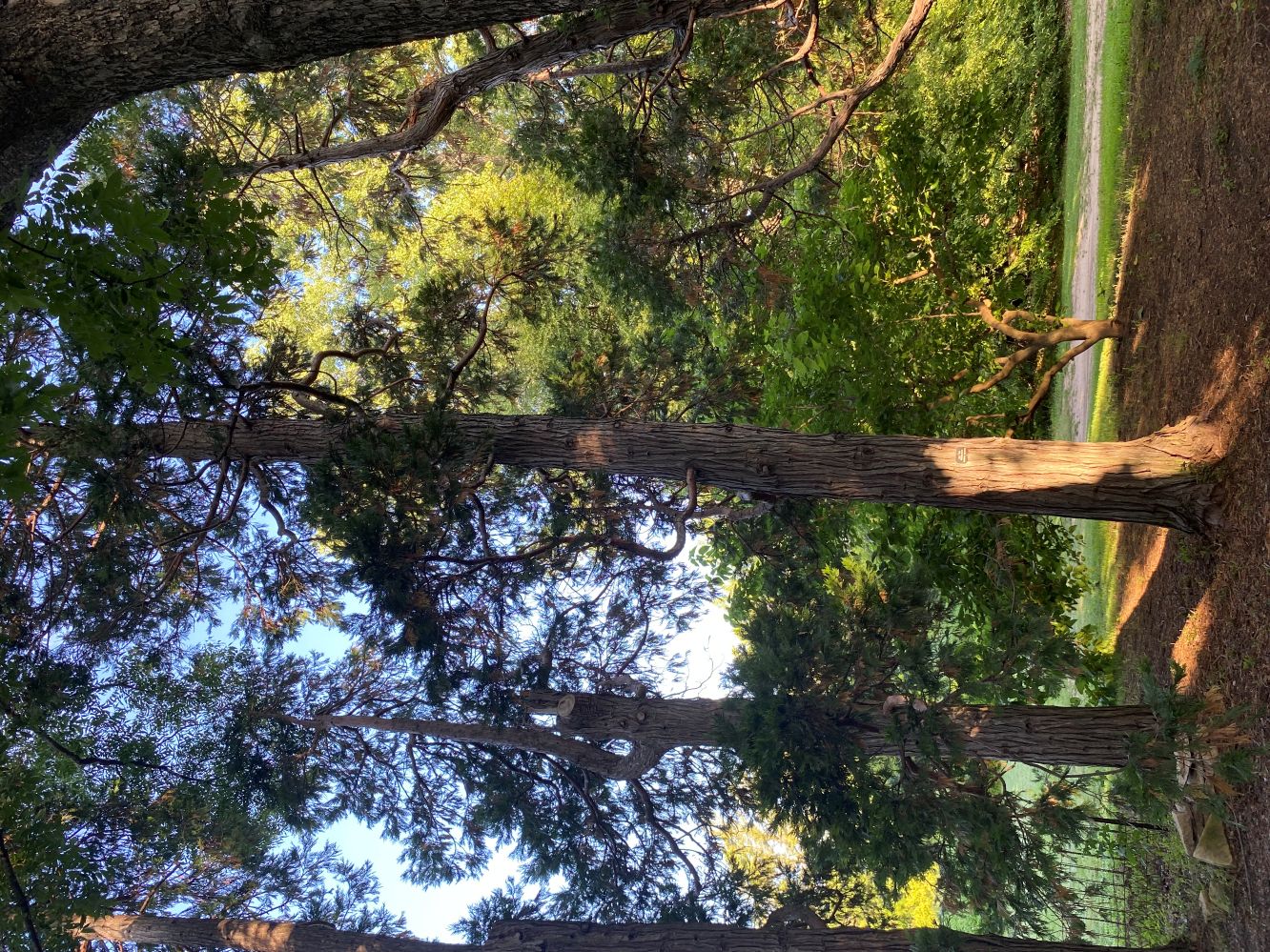 The current co-champion incense cedar at Belle Plaine Arboretum.
Incense cedar has had many uses throughout the ages for its timber thanks to its soft but not splintery wood. The described wood characteristics make it useful for pencil production, furniture, fencing and siding (Powers and Oliver 1990). Native peoples used this timber for brooms (which have the added benefit of releasing the sap and providing fresh air during and after cleaning), bows, arrows, and conical-shaped shelter. The tree has been used medicinally for soothing stomach ailments by creating tea out of the leaves.
All in all, California incense cedar is a useful addition to our state tree ornamental list. It has many desirable characteristics ranging from its aesthetic benefits (small seed cones, bright green foliage, fragrant sap) to ecological benefits (drought and fire tolerance). While this tree is a reasonable addition to the ornamental tree list, that doesn’t mean that it is the right tree for every place in Kansas, this tree is recommended for deep, well-drained yet reasonably moist soils, yet even with those key soil characteristics this is still a slow growing tree. To see local examples of this species might I recommend a visit to the Bartlett Arboretum or to drive by Hays and appreciate the state champions. While the Hays example is an eyes-only experience, the Barlett Arboretum is an immersive one. If those visits seem too far out of the way, you can always feel the soft but not splintery wood that makes it so perfect for pencil production. Remember with the proper environmental requirements and patience, this tree can live up to its namesake.
Chelsea Hanson
Northwest District Forester
Kansas Forest Service