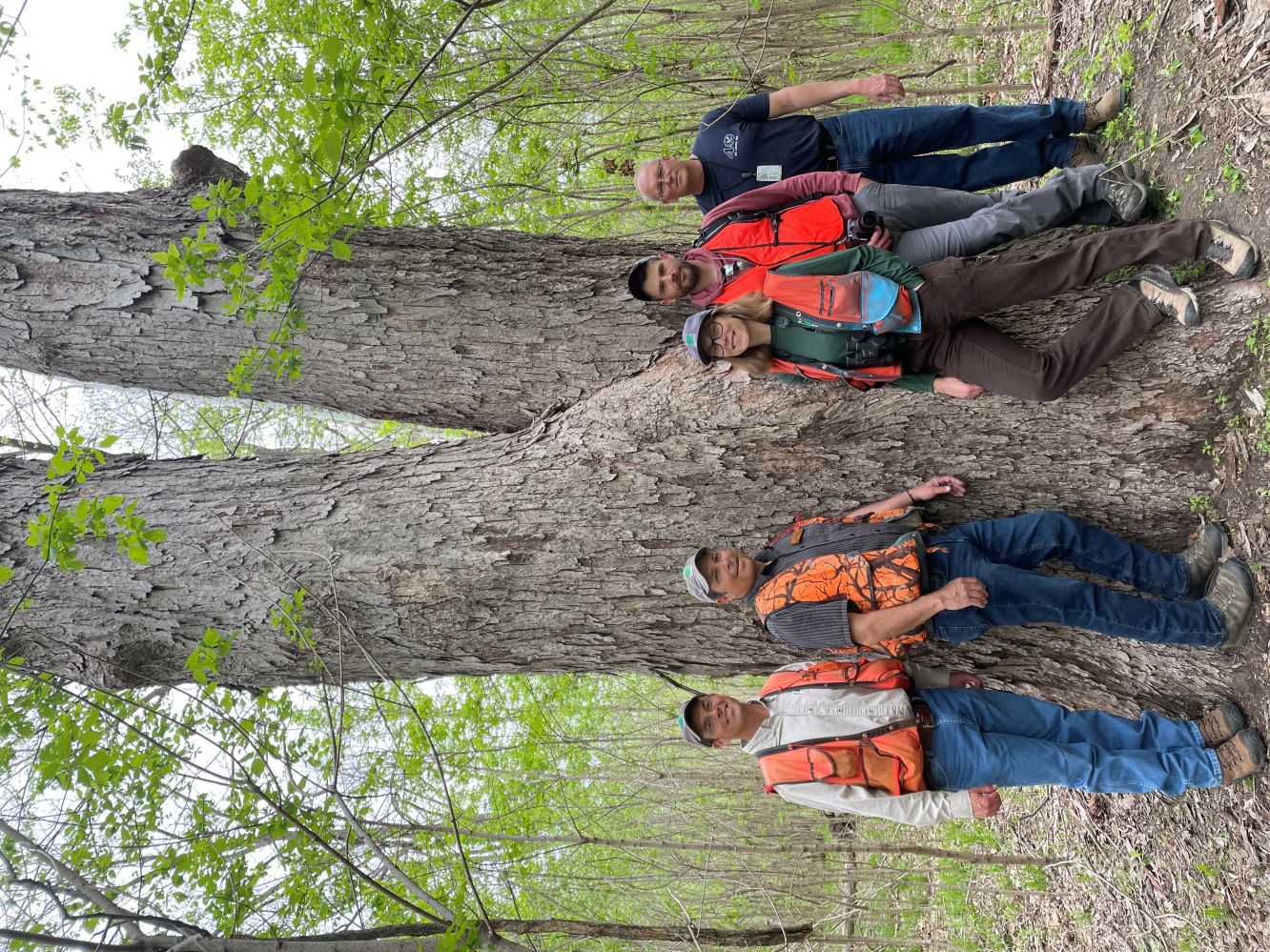
Kansas State Champion Pecan Tree
A Visit to the Old-Growth Pecans of Kansas
Everybody loves big trees. They make you feel wonderfully small and insignificant. They hold a mysterious network of roots, mycorrhizae, and microorganisms concealed well below our feet. They support a crown of leaves, branches, birds, and sunlight held well beyond our reach. The only part of a big tree on our level is the trunk, which by the way, is why you should never sleep on bark ID. Perhaps most remarkably, the lifespans of big trees offer a connection to both the history and future of us humans. Big trees probably aren’t the first things that come to mind when considering the history or future of Kansas, but allow me to convince you otherwise.
Prior to European colonization, the lower Missouri River was an untamed system of meanders, oxbows, sandbars, and wetlands carving dynamic paths across its floodplain. Along its periodically flooded banks, riparian forests grew in moist, nutrient-rich soils. These bottomland forests functioned as biodiversity hotspots and corridors for wildlife movement across the landscape. Species such as pawpaw, Canadian wild ginger, and Gray’s sedge grew under canopies that contained riparian giants; massive cottonwood, hackberry, elm, black walnut, sycamore, oak, and hickory trees. These forests would have seen animals such as bison, elk, pileated woodpeckers, mudpuppies, and great blue herons. The lower Missouri River and its surrounding ecosystems were used by Native American Tribes including the Kaw, Osage, and Missouria for settlement, trade, prayer, burial, food and medicine, and refuge from severe winter weather.
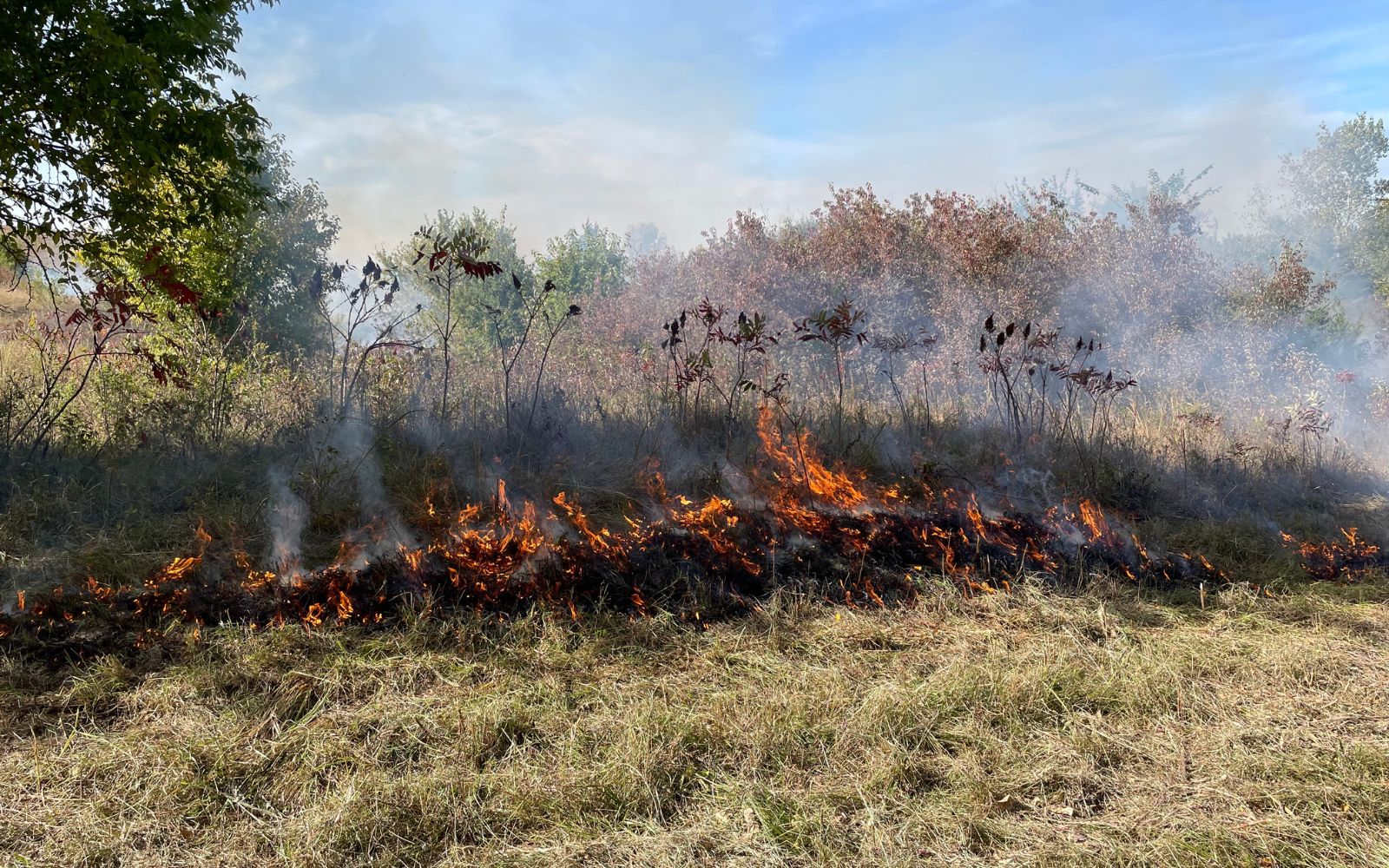
Today, the Missouri River is one of the most altered rivers in the country. The Upper Missouri contains six dams, while the Lower Missouri contains a navigation channel and hundreds of miles of levees. These structures were constructed to address complex water resource demands such as flood control, water supply, irrigation, navigation, hydropower, recreation, and fish and wildlife habitat. Furthermore, many of the forests and prairies of the Missouri River floodplain have been lost to development and agriculture. The resulting river is one that is much less dynamic, buffered, and biodiverse than the historic river who gave rise to the few old-growth riparian forests that remain today.
In 1827, Fort Leavenworth became the first permanent settlement of white Americans on the homelands of the Kaw and Osage peoples in present-day Kansas (Native Land Digital). As the oldest continuously active US military base west of the Mississippi River, it offers a glimpse back into our historic floodplain. The base is home to 200 acres of old-growth forest that has escaped development or conversion to agriculture. If you look at the aerial imagery of northeast Kansas, you’ll see a dark green blob cradled inside one of the more obvious meanders that form our squiggly border with Missouri. This blob is the largest contiguous floodplain forest along the lower Missouri River.
My visit to this forest began in an astoundingly long taco line at a natural resources conference. Luckily, I happened to fill in behind Neil Bass, the Natural Resource Specialist at Fort Leavenworth, and the half-mile line passed quickly thanks to our shared enthusiasm for trees. A few months later, I joined several colleagues and local naturalists to meet with Neil on an overcast April day for a tour of floodplain giants. The gem? A grove of massive pecan trees home to the Kansas champion pecan tree. The Kansas Champion Tree Program, coordinated by Kansas Forest Service and American Forests, maintains records of the largest tree of each species growing in the state. We had the location pinned on our map. Now we just had to get there.
Our hike began on a doubletrack trail that struck northeast through the forest towards the Missouri River. We passed relatively young pecan, box elder, ash, and basswood trees growing over a blanket of sedges. As we moved toward the river, a box elder midstory became more and more dense. Trees were just beginning to leaf out, and the result was a hazy wall of light green box elder saplings vying for a spot among the overstory pecans. It was impressively smothering. We eventually left the trail to pick our way through this seemingly endless sea of box elders and sedges growing under well-spaced canopy trees. Along our route, we gathered morels, snacked on stinging nettle (if you crush up the leaves with your fingers, the hairs won’t get you!), caught a western ratsnake, admired massive cottonwoods, and gazed up at the state champion Kentucky coffeetree.
Thanks to the box elder, we somewhat stumbled into the pecan.; the tree’s enormity an expected surprise. The champion tree rose about 10 feet from the ground as a single trunk with a circumference at breast height of 17 feet 4 inches (that’s 66 inches in diameter for you foresters) before splitting into two towering stems that reached 139 feet in height and 122 feet in crown spread. The vertically flaking bark had hues of grey, chocolate brown, and pink. Pieces of this colorful bark covered the ground; decades worth of phloem that had been shed by secondary growth. Thankfully, I brought binoculars that allowed me to see the crown (seriously y’all, don’t sleep on bark ID). Leaves were just beginning to emerge from swollen buds attached to stout twigs that arched in the swirling curves common to the hickory genus (Carya).

We’re not sure of the exact age of this tree, but estimates put it at well over 200 years old. These pecans germinated when bison and grizzly bears roamed wild across the Great Plains, when Native Americans fully inhabited their ancestral homelands, and when carbon dioxide concentrations averaged 280 parts per million. These trees were seen by Lewis and Clark as they paddled up the Missouri River on July 1, 1804. They were likely seen by the 418 Nez Perce who were held as prisoners at Fort Leavenworth from November 1877 to July 1878 during a long and tragic fight for their homelands in present-day northeast Oregon (Montana Historical Society Press, 2000).
This is the last old-growth pecan grove in Kansas and the northernmost in the country. It is isolated from pecan populations in the southeast portion of the state, so it is thought that Native Americans gathered seeds from trees farther south and planted them in present-day Fort Leavenworth. In her book, Braiding Sweetgrass, Potawatomi author Dr. Robin Wall Kimmerer writes about an Indigenous way of thinking that culminates in such gifts for future generations. She writes, “Collectively, the indigenous canon of principles and practices that govern the exchange of life for life is known as the Honorable Harvest. They are rules of sorts that govern our taking, shape our relationships with the natural world, and rein in our tendency to consume- that the world might be as rich for the seventh generation as it is for our own”.
Looking up at this massive pecan, I can’t help but consider what seeds are being planted for the next seven generations. Will there still be pallid sturgeon swimming in the Missouri River? Will atmospheric carbon dioxide concentrations continue to climb well above today’s 420 parts per million? Will sacred natural spaces be protected and accessible to communities who rely on them? It depends on whether we make decisions based on our lifespans or the lifespans of big trees.
Elizabeth Jamison
Northeast Rural District Forester
Kansas Forest Service