Kansas Forest Service News
State Champion Red and White Mulberry
When it comes to a Mulberry it can be a real headache trying to differentiate between a White Mulberry and a Red Mulberry. Mulberry trees are a fascinating species that belong to the Moraceae family, which is known to hybridize. While they may look similar at first glance, these two types of mulberries have distinct characteristics that set them apart. If you see a Mulberry tree and wonder if it is red or white, here are a few things to look for.
Site selection is huge when it comes to finding pure Red Mulberries. The Red Mulberry prefers moist soil sites and are often found in dense mature bottomlands. The leaves are typically 4-7 inches in length and will be dull/dark green with a sand-papery texture. The underside of the leaf will be slightly hairy, and the margins will be finely serrate. The Red Mulberry will have shiny buds that point away from the twig and will have a black band along the scale. It will typically have a greyish bark with scaly ridges. The fruit of the Red Mulberry is a dark purple when ripe and is much sweeter than the White. The fruit is typically larger than an inch and normally found along the stem. Fruit production is sparse and is a highly valued fruit for our wildlife and can be made into some incredible jams. Deer will target this species throughout the year, and you might notice a heavy browse line on the foliage during the spring and summer months.
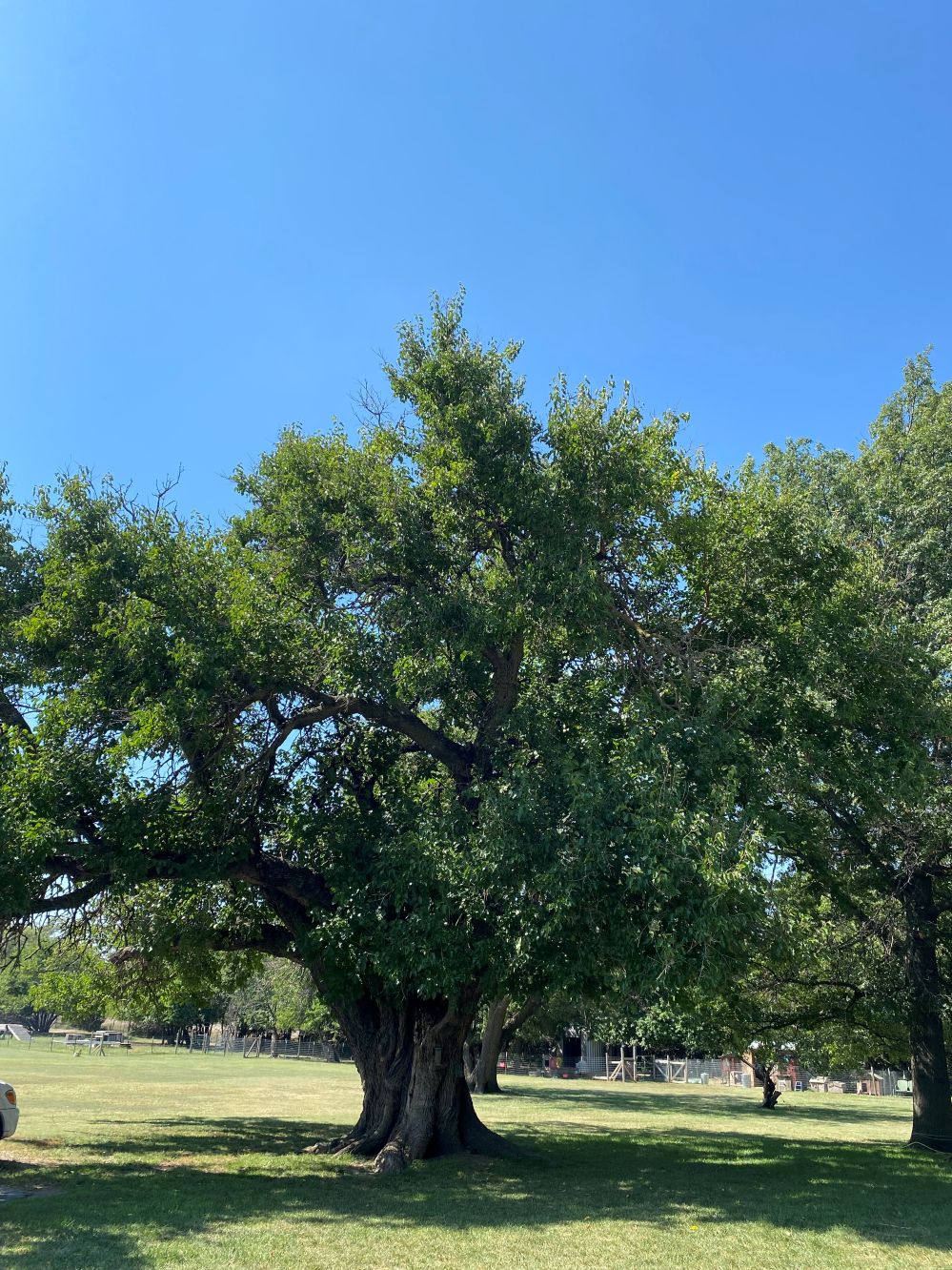 The current Red Mulberry State Champion Tree in Kansas.
White Mulberries site selection can be varied. The tree is typically considered a pioneer species, but is found in disturbed sites, bottomlands, fencerows, and anywhere the seed can take hold. The leaves are normally 2-4 inches and have bright green leaves that are shiny. The underside of the leaf is normally hairless but can have slight hairs along the main vein of the leaf. It will have orange buds with a brown band that stays close against the twig. It will typically have an orange-brown bark with deep furrows. The fruit of the White Mulberry is smaller around ¾ of an inch. The fruit can be prolific and can range in color from white, red, to deep purple when ripe. This fruit is highly valued by our wildlife, and this is a major contributor to the spread of this tree.
When the mulberry hybridizes you will often get a variety of leaf structures with characteristics of both trees. The hybrids can drive you mad when trying to distinguish the species. Since hybridization is so easy for these species it has become concerning that the White Mulberry could dilute the pure Red Mulberry out of existence. More research needs to be done to determine the genetic purity of the existing Red Mulberries in our landscape and what steps we need to take to preserve such an incredible species.
Our Champion Tree Program does an excellent job in identifying and preserving some of our historic trees. When it comes to the state champion Red Mulberry you will have to travel to the western edge of Newton, Kansas. Along North Meridian Road stands a botanical marvel. This mammoth sized tree sits at the edge of a driveway, on 901 N Meridian. Mary Clark measured the tree in 2016 and had a total score of 308. The tree provides a tremendous amount of shade with its’ massive 64-foot crown. The tree also has a 20’4’’ circumference and stands over 48 feet tall. If you would like to see this massive tree up close and personal, please introduce yourselves to the owners before wandering around their yard.
The State Champion White Mulberry can be found in Mound City in Linn Co. Rick Spurgeon measured the tree in 2019 and it had a score of 328. The tree stands at 54’, has a circumference of 21’5’’ and has a whooping 69’ crown spread. The tree is easily accessible and can be seen from the parking lot.
Christopher Mullins
South Central Rural Forester
Kansas Forest Service